

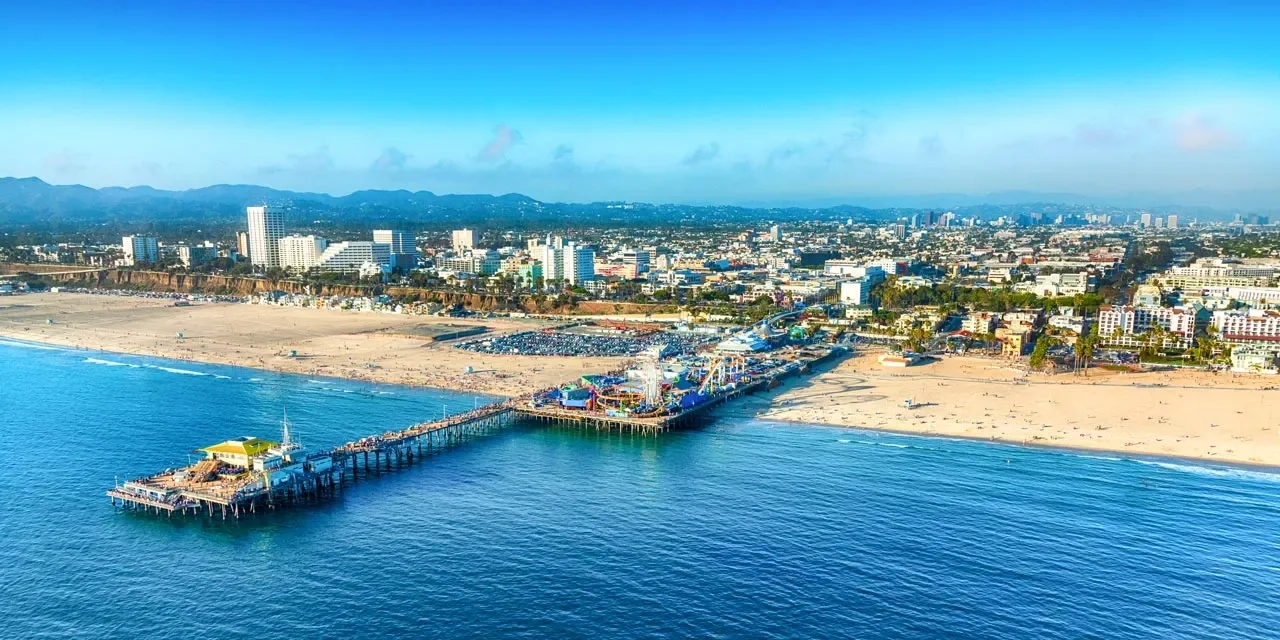
Santa Monica is one of the most recognizable coastal communities in Los Angeles County, blending beachside living with deep civic history and year-round urban energy. The area’s story stretches back to the Tongva, whose presence in the region predates the city by thousands of years, and the modern city took shape in 1875 when Colonel Robert S. Baker and Senator John P. Jones laid out the town. Santa Monica was incorporated in 1886, and from its earliest years it developed around scenic assets, parks, and the coastline rather than simply functioning as a port town.
That origin still helps explain Santa Monica’s appeal today. The city has 3.5 miles of beach within its boundaries, sits on 8.3 square miles of coastline-adjacent land, and is known for mild weather, ocean breezes, and roughly 300 days of sunshine annually. For buyers, that translates into more than postcard scenery. It creates the kind of daily lifestyle people actively search for in Westside real estate: outdoor access, light, walkability, and a setting that feels distinctly Southern California.
Santa Monica also offers a rare mix of historic identity and modern convenience. Landmarks such as Palisades Park, the Santa Monica Pier, and the later revival of the Third Street Promenade helped shape the city into a destination with both heritage and momentum. Palisades Park dates back to the city’s founding era, the pier opened in 1909, and the revitalized Third Street Promenade became one of the defining downtown pedestrian districts in the region. The city’s preservation culture is also unusually strong: a grassroots “Save the Pier” movement in the 1970s helped prevent demolition and led to a lasting local preservation framework.
For homebuyers, Santa Monica’s value is not just that it is famous, but that it functions on multiple levels at once. It offers coastal recreation, established neighborhoods, a major shopping and dining core, and strong access to greater Los Angeles. In 2016, Metro’s E Line extension reconnected downtown Santa Monica to the broader LA rail network, strengthening access between Santa Monica and the rest of the region. Combined with major public spaces like Tongva Park and the long-running draw of downtown, that makes Santa Monica especially compelling for buyers who want a neighborhood experience that feels both livable and connected.
Architecturally and geographically, Santa Monica appeals to a wide range of buyers because it is not one-note. Some are drawn to ocean-adjacent streets and blufftop views near Palisades Park. Others look more closely at the city for its walkable downtown core, historic preservation, or established residential pockets that still feel rooted despite the city’s constant evolution. That breadth is part of what keeps Santa Monica in demand: it offers buyers more than a beach address. It offers a complete Westside lifestyle with history, scenery, commerce, and long-term desirability all working together. This final point is an inference based on the city’s documented history, parks, downtown revival, beaches, and transit connectivity.